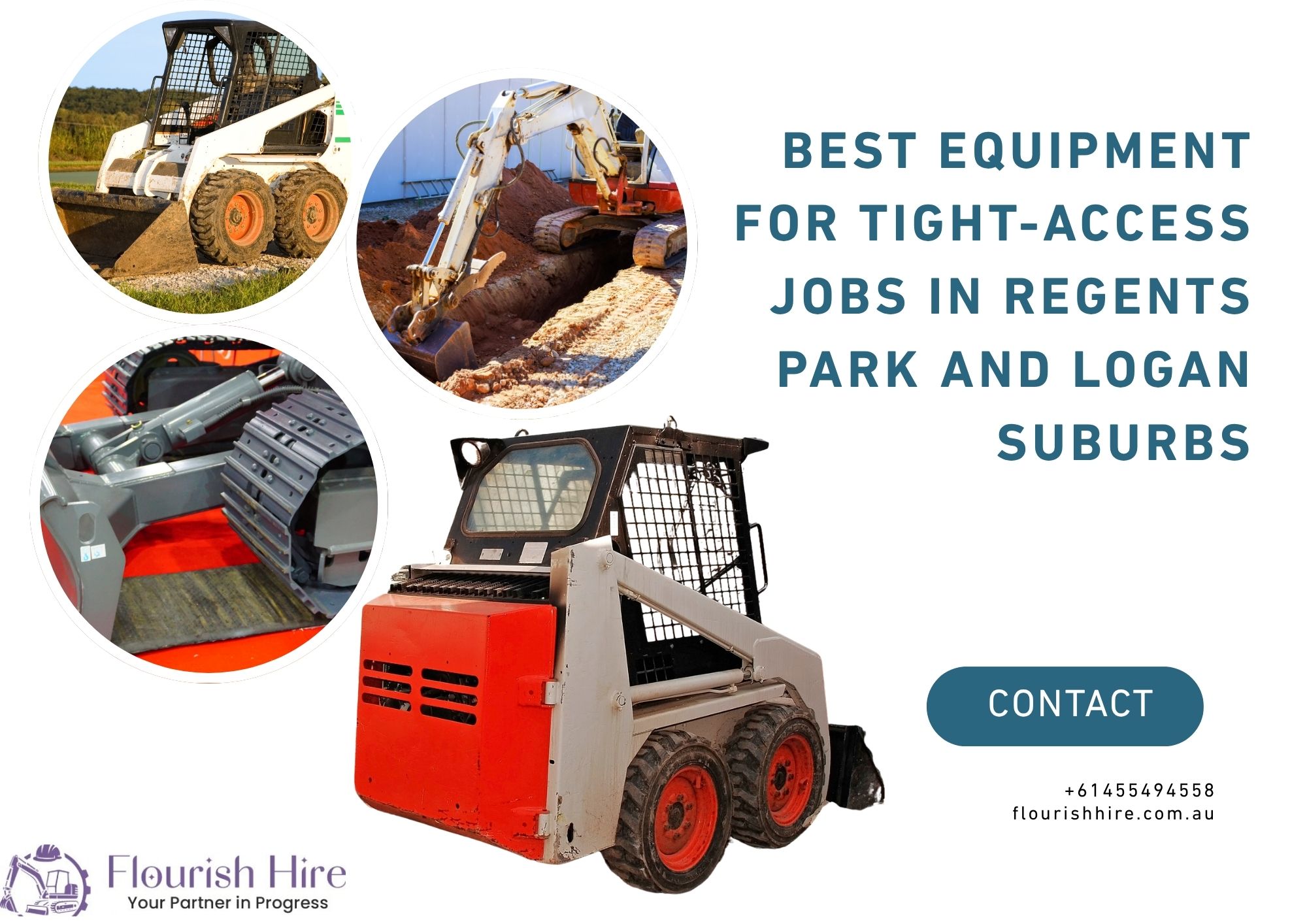
For tight-access jobs in Regents Park and Logan suburbs, the best equipment is a mini excavator (under 1 m wide), a compact track loader, a mini dumper or power barrow, a walk-behind stump grinder, and a compact trencher. These machines fit through standard side gates and narrow side passages, and they cause far less lawn and paving damage than full-size gear. Flourish Hire supplies this kind of equipment to homeowners, landscapers and builders across Logan, from Regents Park and Browns Plains to Springwood and Greenbank.
Why Tight-Access Jobs Are Common in Logan
Many Logan and Regents Park properties have narrow side access, established fencing, and backyards packed with pools, sheds and mature trees. Infill developments and townhouse sites have even less room to move. A full-size excavator or skid steer simply won’t fit, and forcing it through can damage fences, pavers and underground services.
Choosing compact equipment solves three problems:
- Access: Compact machines fit through gates as narrow as 700 to 900 mm.
- Protection: Rubber tracks and lighter weight reduce damage to lawns, driveways and paving.
- Cost: The right-sized machine finishes the job faster and avoids paying for a larger machine you can’t use.
The Best Equipment for Tight-Access Jobs
-
Mini excavators
A mini excavator is the first choice for tight backyard digging. Models in the 1 to 2 tonne range can be under 1 m wide, and many have retractable tracks that narrow further to pass through a gate, then widen for stability once you’re set up.
Best for: footings, drainage trenches, pool and pond excavation, retaining wall bases, services trenching and removing old garden beds.
-
Compact track loaders and skid steers
Compact loaders move soil, gravel, mulch and debris quickly. Tracked versions spread their weight and are gentler on turf than wheeled machines. Check the machine’s width against your narrowest point before you book.
Best for: levelling, spreading base material, clearing spoil, and loading trucks or skip bins.
-
Mini dumpers and power barrows
Moving material is often the real bottleneck on tight sites. A tracked power barrow or mini dumper carries several wheelbarrow loads at once, over uneven ground and up slopes, without a strained back.
Best for: moving concrete, sand, soil and pavers from the street to the backyard.
-
Stump grinders
Walk-behind stump grinders are narrow, manoeuvrable and quick. They remove stumps near fences and buildings, where an excavator couldn’t reach without damage.
Best for: tree removal follow-up, clearing new garden areas and prepping for turf or paving.
-
Trenchers and post hole borers
A compact trencher cuts clean, uniform trenches for irrigation, cabling and drainage with little disturbance. A post hole borer makes fencing and deck footings fast, even in compacted Logan clay.
Best for: fence lines, pergolas, irrigation, landscape lighting and conduit runs.
-
Plate compactors and rammers
After digging, you need to compact the base. Plate compactors suit paving and driveways, while trench rammers get into narrow trenches and around footings.
Best for: paving bases, retaining wall foundations and backfilled trenches.
How to Choose the Right Machine for Your Site
Use this simple checklist before you hire:
- Measure the narrowest point. Check gates, side passages, and gaps between the house and fence. Allow a little clearance on each side.
- Check ground conditions. Soft or sloping ground suits tracked machines. Hard surfaces may need track pads or protective boards.
- Match machine size to the task. Bigger isn’t better in tight spaces. A 1.5 tonne mini excavator can often do the work of a larger machine with less mess.
- Plan the spoil. Decide where excavated soil will go: skip bin, truck, or onsite. This helps you choose between a loader and a dumper.
- Check for underground services. Always use Dial Before You Dig before any excavation.
- Ask about attachments. Augers, buckets, breakers and trenching buckets add flexibility to one machine.
Safety Tips for Working in Confined Spaces
- Confirm operator experience, as some machines require training or a licence depending on the task.
- Keep bystanders, children and pets well clear of the work area.
- Watch for overhead powerlines, tree branches and low eaves.
- Work on stable ground and avoid sharp slopes.
- Wear the correct PPE: boots, gloves, eye and hearing protection.
- Check the machine before use for leaks, loose parts and fuel or oil levels.
Why Hire Instead of Buy?
For most one-off or seasonal jobs, hiring makes better financial sense. You avoid purchase costs, servicing, storage and transport, and you can choose the exact machine for each job. Hiring from a local supplier also means practical advice from people who know Logan’s soil, access challenges and typical block layouts.
Why Choose Flourish Hire?
Flourish Hire is a locally based equipment hire business serving construction and landscaping jobs across Logan and nearby suburbs, including Regents Park, Browns Plains, Springwood, Marsden and Greenbank. Our team helps you match the machine to the site, so you get equipment that actually fits your access, not just your budget.
Ready to get started? Contact Flourish Hire at flourishhire.com.au to check availability and get advice on the best compact equipment for your project.
Frequently Asked Questions
-
What is the best machine for a backyard with narrow side access in Logan?
A mini excavator with retractable tracks is usually the best all-rounder. Many models are under 1 m wide and some narrow further, so they fit through standard side gates. Pair it with a power barrow or mini dumper to move material.
-
How narrow a gate can a mini excavator fit through?
Compact models start at around 700 mm wide, and many sit between 700 mm and 1 m. Measure your narrowest gate or passage first, then confirm the exact machine width with your hire provider.
-
Will compact equipment damage my lawn or paving?
Rubber-tracked machines spread their weight and cause much less damage than wheeled or heavy machines. Using ground protection mats or boards over paving and lawns reduces the risk further.
-
Do I need a licence to operate tight-access equipment?
Requirements depend on the machine and the type of work, particularly for commercial sites. Many compact machines are suitable for competent DIY users, but you should always ask your hire provider about training, licensing and safety requirements before you book.
-
What equipment is best for removing a stump close to a fence?
A walk-behind stump grinder is ideal. It’s narrow and controllable, and it grinds the stump below ground level without needing machine access to dig it out.
-
Is it cheaper to hire or buy equipment for a one-off job?
For one-off or occasional jobs, hiring is almost always cheaper. You skip the purchase price, maintenance, insurance and storage costs, and you can pick the right-sized machine for each project.