
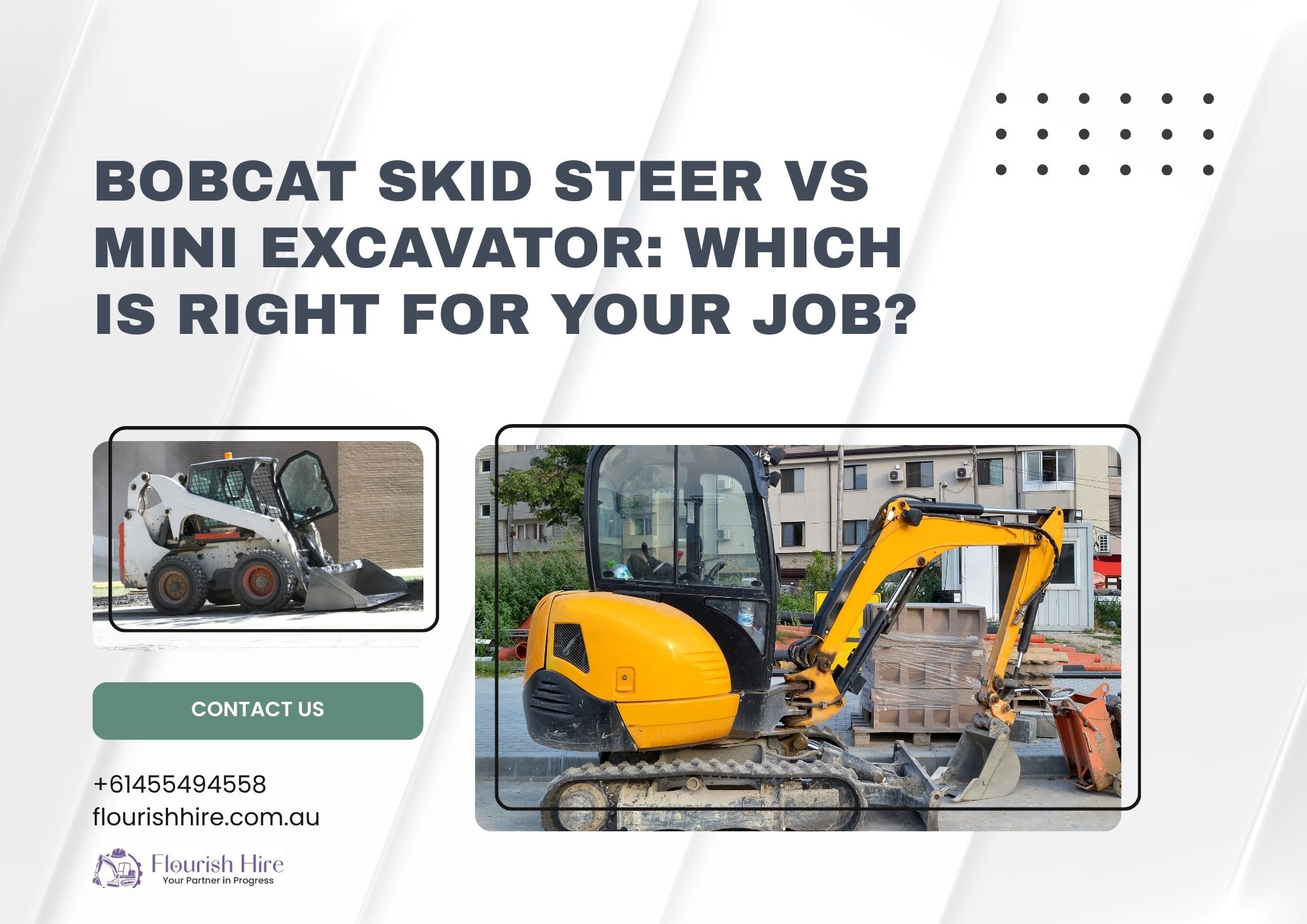
Choosing the right compact machine can make a major difference to how efficiently you complete a landscaping, construction, excavation or backyard project. Two popular options are a Bobcat skid steer and a mini excavator. While both machines are designed for compact worksites, they perform very different types of work.
So, which should you choose: a Bobcat skid steer or a mini excavator?
The simple answer is this: choose a mini excavator when digging is the main task, and choose a skid steer when moving, loading, grading or spreading material is the priority. Your site access, ground conditions, attachments and project requirements should also influence the decision.
For customers around Greenbank, Brisbane and Logan, Flourish Hire offers compact equipment designed for residential, landscaping and light commercial work. Its range includes the Bobcat S70 skid steer and compact excavators such as the Bobcat E17z 1.7-ton excavator.
What Is a Bobcat Skid Steer?
A skid steer is a compact loader designed primarily for moving and handling materials. Instead of using a boom and digging arm like an excavator, the machine uses a front-mounted attachment system.
The Bobcat S70 available from Flourish Hire is designed for tight-access earthmoving, loading, site clean-ups, landscaping preparation and small slab preparation. Its compact 1,150 mm width makes it suitable for many restricted-access residential sites.
With the right attachment, a skid steer can handle tasks such as:
- Moving soil, mulch and gravel
- Loading and unloading materials
- Levelling and grading
- Landscaping preparation
- Driveway preparation
- Site clean-up
- Light material handling
- Small slab preparation
- Using attachments such as buckets, forks, sweepers and augers
This makes a Bobcat skid steer particularly useful when your project involves moving material from one place to another.
What Is a Mini Excavator?
A mini excavator is built primarily for digging and excavation work. It uses a boom, arm and bucket to remove soil and reach below ground level.
For example, Flourish Hire’s Bobcat E17z 1.7-ton excavator is designed for tight-access digging, trenching, footings, landscaping and small-site preparation. Its zero-tail-swing design and retractable undercarriage are useful when working around walls, fences and restricted entrances.
A mini excavator can be suitable for:
- Trenching
- Drainage preparation
- Footings
- Garden excavation
- Retaining wall preparation
- Removing soil
- Small-scale earthworks
- Landscaping projects
- Working around structures and boundaries
If the primary question is “Which machine is better for digging?”, a mini excavator is generally the more appropriate machine because digging is its core function.
Bobcat Skid Steer vs Mini Excavator: Key Differences
The biggest difference is how each machine interacts with the ground.
| Project Requirement | Bobcat Skid Steer | Mini Excavator |
|---|---|---|
| Digging trenches | Limited | Excellent |
| Moving soil | Excellent | Good |
| Grading and levelling | Excellent | Good |
| Excavating footings | Limited | Excellent |
| Loading materials | Excellent | Moderate |
| Landscaping | Excellent | Excellent |
| Drainage work | Limited | Excellent |
| Site clean-up | Excellent | Good |
| Working close to walls | Good | Excellent |
| Material spreading | Excellent | Moderate |
This comparison is not about one machine being universally better. It is about matching the machine to the work you need to complete.
When Should You Hire a Bobcat Skid Steer?
A Bobcat skid steer may be the better option when your project involves considerable material movement.
For example, imagine you are preparing a backyard for landscaping. You need to move soil, spread aggregate, clear garden waste and level sections of the site. A skid steer can perform these material-handling and preparation tasks efficiently.
The Bobcat S70 also supports Bob-Tach attachments, allowing the machine to be configured for different jobs. Flourish Hire lists compatible options including buckets, pallet forks, sweepers, augers, breakers, landplanes, stump grinders and tillers.
For landscaping, driveway preparation, site clean-ups and material handling, a compact skid steer can therefore be a practical choice.
When Should You Hire a Mini Excavator?
A mini excavator is generally the better choice when your project requires controlled excavation.
Suppose you need to dig a trench for drainage, prepare footings or remove soil beside an existing structure. The excavator’s boom, arm and bucket provide the digging capability required for these tasks.
The Bobcat E17z is specifically designed for tight-access excavation and features a retractable undercarriage that can narrow for access and extend for greater stability during work.
For trenching, drainage, footings, excavation and digging around established areas, a mini excavator should usually be considered before a skid steer.
What About Tight Access?
Access is one of the most important factors to check before booking equipment.
Measure the narrowest gate, pathway or entrance the machine needs to pass through. Also consider overhead clearance, turning space and the surface leading to your work area.
Flourish Hire’s Bobcat S70 has a listed overall width of 1,150 mm, while its Bobcat E17z has a retractable undercarriage ranging from approximately 980 mm to 1,360 mm.
This means that even within the compact equipment category, machines have different access requirements. Measure first and book second.
Can You Use Both Machines on One Project?
Yes. Some projects benefit from using an excavator and skid steer together.
For example, during a landscaping project, the mini excavator can dig and remove soil while the skid steer moves the excavated material around the site. This can reduce manual handling and create a more efficient workflow.
For larger or more involved projects, Flourish Hire also has other compact earthmoving options, including a tracked mini skid steer and additional excavator sizes.
The right combination depends on the site, material, access and scope of work.
Dry Hire or Wet Hire?
Another decision is whether you need dry hire or wet hire.
With dry hire, you operate the machine yourself, subject to the applicable hire requirements and your ability to safely operate the equipment.
With wet hire, equipment is supplied with an operator where available and appropriate for the job. Flourish Hire offers both dry and wet hire options and recommends discussing the project when the work is complex, higher-risk or time-sensitive.
If you are unsure which option is suitable, explain the project, site access and type of work before booking.
Which Machine Should You Choose?
The best choice depends on what you actually need the machine to do.
Choose a Bobcat skid steer if you mainly need to:
- Move large amounts of loose material
- Load or unload materials
- Grade and level surfaces
- Prepare landscaping areas
- Clean up a worksite
- Spread soil, gravel or other materials
Choose a mini excavator if you mainly need to:
- Dig trenches
- Prepare footings
- Excavate soil
- Work around walls and structures
- Prepare drainage
- Complete controlled digging and earthworks
Before booking, consider access width, ground conditions, digging depth, material volume, attachments, transport and operator requirements.
Hire Compact Earthmoving Equipment from Flourish Hire
Flourish Hire provides equipment hire from Greenbank, Queensland, with delivery available within 50 km and a range of compact machines for landscaping, construction and residential projects. Its equipment range includes the Bobcat S70 skid steer, Bobcat E17z excavator and other earthmoving equipment.
If you’re unsure whether a Bobcat skid steer or mini excavator is right for your project, contact Flourish Hire with your job details. Sharing your site access, material type and intended work can help identify the equipment that best matches the job.
Frequently Asked Questions
1. Is a Bobcat skid steer better than a mini excavator?
Neither machine is universally better. A skid steer is generally suited to material handling, grading and site clean-up, while a mini excavator is designed primarily for digging, trenching and excavation.
2. What is better for digging: a skid steer or mini excavator?
A mini excavator is generally better for digging because its boom, arm and bucket are specifically designed for excavation and controlled digging.
3. Is a Bobcat skid steer good for landscaping?
Yes. A compact skid steer can be useful for landscaping preparation, moving soil and materials, grading, clean-up and other site-preparation tasks. The Bobcat S70 is designed for these types of compact-site applications.
4. Can a mini excavator work in a backyard?
Yes, provided the machine can safely access the site. Compact excavators such as the Bobcat E17z are designed for restricted-access residential and landscaping projects. Always measure your access before booking.
5. Should I hire both a skid steer and mini excavator?
For some larger landscaping or earthmoving projects, using both can be practical. The excavator can focus on digging while the skid steer handles material movement, grading and clean-up.
6. How do I choose the right machine for my project?
Start with four questions: What needs to be dug? What needs to be moved? How much space is available? Which attachments are required? You can then discuss these details with Flourish Hire to identify a suitable machine and hire option.